
There are Ghosts in this Machine: AI Anonymization and the Identification of Self
What happens when the tools designed to protect research participants end up either 1) obscuring their facial expressions or 2) preserving their features but making them appear ghastly? Are there other options?
By María José Peláez, Kai Blevins, and Joel Kuipers
July 9, 2026
In the summer of 2025, the three of us —María José Peláez, Kai Blevins, and Joel Kuipers— worked at The George Washington University Discourse Lab with two different large datasets of video transcripts running to several hundred pages. The first was a NIMH dataset collected in 1999–2000 (PI Joyce Chung, co-PI Joel Kuipers) in which women were interviewed by healthcare professionals over the course of one year while taking psychiatric medication after having experienced traumatic events; the second came from Montgomery County Public Schools and documented 7th-grade students doing experiments in science classrooms from 2001-2009 (co-PIs Sharon Lynch, Joel Kuipers, and Curtis Pyke). With both datasets, we wanted to find out whether qualitative analysis software like MAXQDA, paired with large language models (LLMs), like Claude, could help linguistic anthropologists make sense of multimodal data at large scales—organizing diverse material and detecting linguistic processes such as nominalization.
Initially, the three of us simply intended to end the summer having written a student handbook with the findings and steps for leveraging these LLMs to conduct analysis with rigor and care. But during our working sessions at the Discourse Lab, we found ourselves spending as much time debating the ethics of using these tools in the first place as actually drafting the step-by-step guide.
The ethical concerns we had stemmed from a fundamental intuition: If anthropology’s critical edge depends on what Ruth Behar calls “The Vulnerable Observer”[i]—the researcher’s willingness to be affected by and accountable to research participants—what happens when AI systems increasingly mediate the relationship between the two? We have started to think about the “algorithmic distancing,” the illusion of objective knowledge production that obscures its own power relations while training students to treat human complexity as computational input, as sets of patterns and repetitions located in amorphous spreadsheets.
Early Contentions
Some of the greatest points of contention in relation to that algorithmic distancing emerged early in our tests at the Discourse Lab. If we wanted future students to be able to use the transcripts, videos, and the audio files located at the Lab—many of them sensitive in their subject matter, like the NIMH dataset described before, and all protected by IRB codes of ethics—we would have to anonymize them all so no participant could be recognizable, and no document could be shared outside of the academic-classroom context. The question of how to do that for hundreds of multimodal materials became, inadvertently, our main research for the summer.
This blog post is an opportunity for us to think with readers and receive comments on anonymization and participant protection practices for large archives of linguistic material. It is also an opportunity to share our own experiences at the GWU Discourse Lab iterating and testing different software for doing so.
Hauntings of Color Negatives
During the first couple of weeks of our summer research, Kai worked on finding software we could use for the anonymization that was both ethically developed and sourced, and allowed by GWU. We needed software by companies that do not share datasets with third parties and do not store uploads in clouds, among other restrictions. Our privacy requirements narrowed the possibilities significantly. In the end, we went with Adobe Premiere Pro, a program we have access to through GWU, and Kai began experimenting.[ii]
In the beginning, we iterated with the “video color invert effect” (color negative) function in Premiere Pro. This functionality preserves all contextual cues, like the setting of an interview and the participant gestures, but it alters the color palette to fluorescent and accentuates the shades, making it difficult to individually identify the person (see image below).
Robust linguistic analysis requires all the layers of meaning-making that happen beyond words; the extralinguistic features of communication—the gestures, facial expressions, gaze, the physical setting that shape what is said. In that sense, the color negative function seemed like a good solution. However, the three of us also agreed that there was something profoundly unsettling about those bluish color-negative videos; something almost phantasmagoric.
We recognized that color negatives offered a solution to many of the problems we were facing—anonymization, de-identification—but they introduced new problems. The images felt uncanny, ghostly, ghastly. Surreal. But more so, we felt that the strange inversion of color affected our own perception and reactions to the testimonies in the datasets in ways that would not have happened with color imagery that seemed more “true to life.”
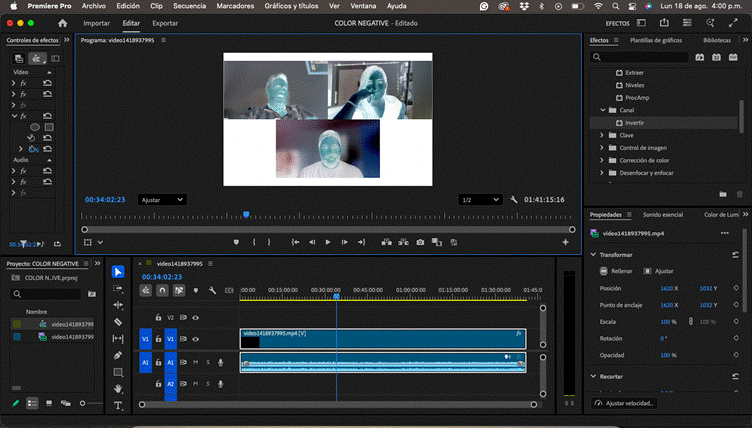
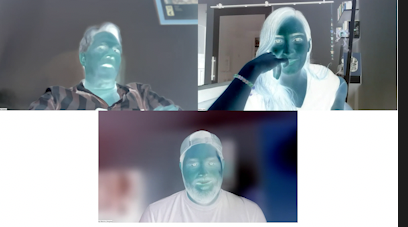
Our discussions at the Discourse Lab exposed some dilemmas: between protecting the identity of subjects in the datasets—our first and most important priority—and the risk of changing key qualities of the data and the human experience with what is said and heard in the process.
We were more than aware, that new researchers would have access only to these AI-anonymized and modified datasets, making it almost impossible for them to preserve and verify the “reality” of the data, or to even trace it to the real people who once gave their testimonies years ago. What will future students and researchers lose, then, when approaching materials only in the color-negative format? How does it emotionally impact the researcher to spend hours gazing at ghostly figures distorted by the fluorescent overlay? And finally, were we even sure that these color negatives could not be reversed?
Working with large-scale datasets anonymized exclusively through AI-made color inversion could change anthropological practice and how we have understood the field to this day in unforeseen ways.
Face Generation and Phantasmagoric Ventriloquism
All these considerations with the color negatives led us to try to find other options for data protection, such as face generation technologies, which create synthetic human faces using AI models. Face generation tech mimics and preserves participant facial movements (gestures) but generates a face that does not correspond to the real individual (see image below). Most companies offering this service promote it as a cutting-edge, futuristic solution for safeguarding privacy and anonymity. However, our tests revealed more concerning patterns. For example, one of these software companies completely modified the participants’ features, such as skin tone, hair texture, eye shape, weight, or height. Indeed, gestures were still preserved, but characteristics of race and ethnicity appeared randomly interchangeable or completely erasable from the original source.
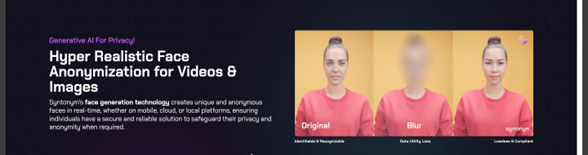
What we were witnessing in our practice connects to what Susan Gal and Judith Irvine call “fractal recursivity”[iii]: the way distinctions made at one level get reproduced at other levels. When AI systems casually reassign racialized features, they are not just anonymizing; they are reproducing ideologies about which aspects of personhood matter, and which can be discarded. Following Asif Agha’s work on how social identities become meaningful through embodied signs[iv], we started asking: what kind of anthropological knowledge can emerge when gesture gets severed from the racialized, gendered embodiment that contextualizes it? For us, that uncertainty—in which it was sort of the person but sort of not—pushed us to another round of questions that we had not foreseen up to that point in the research.
The Participant’s Gaze
When flipping the coin and asking not only about the researcher’s phenomenological experience with the object of study (the anonymized datasets) but also about the participants in the datasets themselves, we started to wonder about what would happen if participants from our own research and case datasets were able to see the videos today and saw that their testimonies—the interviews they consented to give decades ago—had been taken over by AI avatars and transformed into personas they cannot even recognize.
How will participants feel when they see their gestures, voices, and living presence transformed into surreal AI-modified versions—avatars, pixelated ghosts, anonymized but uncannily familiar? We would like to keep exploring this further—the ethical, aesthetic, and archival problems that arise when anonymization does not just blur a face but alters the very terms of recognition. Maybe this is a dichotomous inquiry about protection versus recognition (if forced to decide, would the participant prefer protection over recognition of their own face?), or perhaps posing the question in those terms is itself a fallacy.
The Face and the Testimonial Subject
For a long time, scholars have talked about the “face-to-face” interaction as essential for ethnographic research.[v] That essentiality has been debated,[vi] and we have learned from patchwork ethnography that interaction, proximity, and encounter can take multiple forms, temporalities, and spaces—and not be less careful or rigorous for that reason. However, as much as we still think through that literature to pose all the questions we have been asking throughout this blog post, we want to insist that the experience of participants encountering themselves in these synthetic forms has not, to our knowledge, received sustained scholarly attention.
Practices of anonymization and data protection, both analog and digital, are, hence, never neutral. Color-negative anonymization is not a neutral transformation of the data; while it preserves gestures and settings, as said, it also introduces new, unintended emotional framings that are not part of the original interaction. If the medium alters how the interaction reads, the representation risks becoming misleading rather than merely disguised.
Also, for the case of our datasets, in particular, we had to grapple with questions of consent and assent. Certainly, the women in the NIMH dataset and the students in the Montgomery County Science Education dataset had consented to being videotaped for the period of the research and understood that the footage would be anonymized if published and used for academic purposes. However, whether that consent extended to the kinds of digital manipulations we have been describing is far less clear.[vii] When people give testimony, they are asserting not just the truth of their experiences but their very capacity for truth-telling.
We do not yet know how the participants in the GW Discourse Lab datasets would feel if they saw their interviews mediated or performed by AI (whether color-negative ghosts or face generation technology). This could become a line of research in itself—not just for these datasets, but for any linguistic anthropologist working with sensitive corpora and trying (as we all should) to work and learn with participants in all steps of the research process. What we do know, from our own fieldwork experience and possibly that of many readers, is that people want their stories told not only on the terms they decide, but by themselves.
Anticipations
We are aware of the speculative character of the inquiries we have been posing across this blog post, and the last thing we want is to appear entirely opposed to these tools. In fact, as we said, we still intend to produce the handbook for students to work with some digital functionalities and tools when doing linguistic anthropology with large corpora. This is more of an attempt to attune to some of the questions AI usage inevitably raises if we want to remain vigilant about corporate predesigns, omissions, and core anthropological and ethical concerns.
***
Anonymization tools are not simply logistical problems requiring better technical solutions; they raise fundamental questions about anthropology itself and knowledge production. Member checking[viii] could be one possible approach to anonymization practices that might address some of the concerns. Rather than imposing our own aesthetic and analytical frameworks on participants’ images, we might consider involving them in decisions about how their testimonies should be visually mediated.
Opening this conversation with participants, showing them the various interventions we apply to their videos, images, and voices, could potentially offer greater control over the aesthetics of their testimony while fostering what Candela calls a “reflective experience” with their own narratives.[ix] This approach acknowledges, however, a tension between researcher analysis and participant voice, requiring a constant dialogical process that attempts to knit together critical interpretation with participant autonomy and that is not afraid of the discussions in between.
Moving forward, we are exploring anonymization techniques that might preserve more of the embodied and contextual richness we have seen disappear in color negatives and face generation. Line drawings or sketch effects (see image below), for instance, appear to maintain gestural and paralinguistic features while creating a “warmer” aesthetic that does not invoke the phantasmagoric qualities we have observed. Yet even these seemingly gentler interventions raise similar questions about recognition and the ethics of representation.
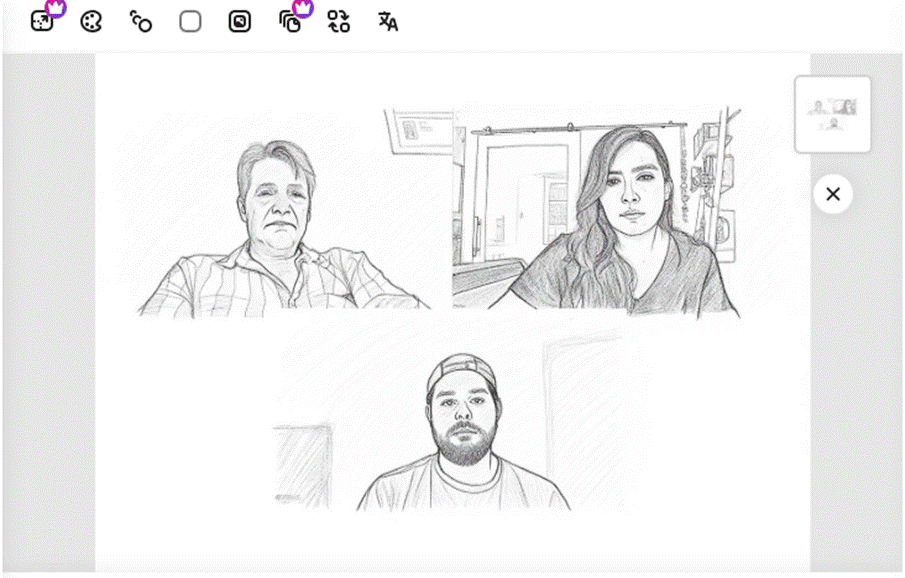
As we consider how to train students (and ourselves!) to work with and navigate AI-mediated datasets, these questions become particularly pressing: how do we understand these tools not as neutral solutions but as interventions that reshape both data and the social relationships that data represents? The question may not be whether we can perfect anonymization technology, but whether we can develop practices that better account for the complexity of those who share their stories with us.
So, what are we doing when, under the umbrella of making data accessible for students or others, we anonymize to the point that participants cannot even recognize themselves? Will we all become ghosts in the machine?
[i] Ruth Behar, The Vulnerable Observer: Anthropology That Breaks Your Heart (Boston: Beacon Press, 1996). Behar argues that ethnography retains its critical force only when the researcher is willing to be emotionally implicated in—and accountable to—the people whose lives she documents.
[ii] The Adobe Suite stores data in the cloud by default. However, it gives users the option to opt out of features like cloud storage to have more control over privacy settings.
[iii] Susan Gal and Judith T. Irvine, “Language Ideology and Linguistic Differentiation,” in Regimes of Language: Ideologies, Polities, and Identities, ed. Paul V. Kroskrity (Santa Fe: School of American Research Press, 2000), 35–83. “Fractal recursivity” names the process by which a distinction salient at one level of social life is projected onto other levels.
[iv] Asif Agha, “Enregisterment,” Oxford Research Encyclopedia of Linguistics, January 30, 2024, https://oxfordre.com/linguistics/view/10.1093/acrefore/9780199384655.001.0001/acrefore-9780199384655-e-1023.
[v] On the face and face-to-face interaction, see Erving Goffman, “On Face-Work: An Analysis of Ritual Elements in Social Interaction,” Psychiatry 18, no. 3 (1955): 213–231; Goffman, Interaction Ritual: Essays on Face-to-Face Behavior (New York: Pantheon Books, 1967); Emmanuel Levinas, Totality and Infinity: An Essay on Exteriority (Pittsburgh: Duquesne University Press, 1969); Levinas, Otherwise than Being: Or Beyond Essence (Pittsburgh: Duquesne University Press, 1987); Penelope Brown and Stephen C. Levinson, Politeness: Some Universals in Language Usage (Cambridge: Cambridge University Press, 1987); Giorgio Agamben, Means Without End: Notes on Politics (Minneapolis: University of Minnesota Press, 2000); and Heidi E. Hamilton, Language, Dementia and Meaning Making: Navigating Challenges of Cognition and Face in Everyday Life (Cambridge: Cambridge University Press, 2019).
[vi] Gökçe Günel, Saiba Varma, and Chika Watanabe, “A Manifesto for Patchwork Ethnography,” Fieldsights, June 9, 2020, https://www.culanth.org/fieldsights/a-manifesto-for-patchwork-ethnography.
[vii] After the first iterations, all software testing has been conducted on María José, Kai, and Joel’s Zoom meeting screenshots and video fragments rather than on the datasets themselves, due to ongoing uncertainty. Until we establish a clear collaborative protocol for handling the Discourse Lab datasets as pedagogical materials, none will be shared or distributed.
[viii] Amber G. Candela, “Exploring the Function of Member Checking,” The Qualitative Report 24, no. 3 (2019): 619–628, https://doi.org/10.46743/2160-3715/2019.3726. Member checking is a qualitative research technique in which researchers present provisional findings, interpretations, or raw data to the participants who provided them for review and feedback.
[ix] Candela, “Exploring the Function of Member Checking,” 619.
Do you have an idea for a blog post? Learn about the SLA Blog and how to submit here.