Welcome to the Society for Linguistic Anthropology Blog!

In 2018, the Society for Linguistic Anthropology’s Board went live with the SLA Blog, a membership-driven project that showcases original linguistic anthropological research via accessible, public-facing articles about diverse topics. The SLA Blog aims to facilitate dialogue among SLA members at all stages in their learning and research while also nurturing a welcoming, engaging space for readers who are not linguistic anthropologists. We invite submissions on all topics relevant to the far reaching scope of language and culture.
- There are Ghosts in this Machine: AI Anonymization and the Identification of Self
 There are Ghosts in this Machine: AI Anonymization and the Identification of Self What happens when the tools designed to protect research participants end up either 1) obscuring their facial expressions or 2) preserving their features but making them appear ghastly? Are there other options? By María José Peláez, Kai Blevins, and Joel KuipersJuly 9,… Read More »There are Ghosts in this Machine: AI Anonymization and the Identification of Self
 - Marcyliena Morgan, 1950-2025
 Marvin Sterling Prof. Marcy Morgan was co-chair of my MA and PhD committees in the Department of Anthropology at UCLA. My MA thesis explored the experiences of African American military personnel at a naval base in Japan. As part of my graduate coursework, I took Prof. Morgan’s seminar in African American linguistics. At some… Read More »Marcyliena Morgan, 1950-2025
 - They don’t see a problem, we don’t see the desire for connection: Indifference to language loss in Papua New Guinea and its challenge for research
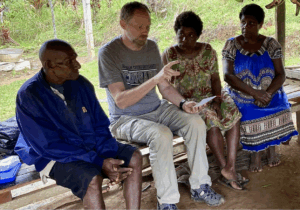 -Lise M. Dobrin and Don Kulick How could language endangerment, which many scholars see as an alarming problem, be largely invisible to the people whose languages are being lost? Discomfiting comments are sometimes tucked into descriptions of Papua New Guinea (PNG) languages. Consider the following examples: “Kuot speakers do not seem to be emotionally attached… Read More »They don’t see a problem, we don’t see the desire for connection: Indifference to language loss in Papua New Guinea and its challenge for research
 - A Navajo Poetry of Place
 -Anthony K. Webster How sad it is that persons bent on debunking Native traditions in Alaska…have used linguistically naive variant spellings of Native place names to assert that the Native toponomy is amorphous and ever-changing. (Kari 1989: 139) We create trust by hanging out with people in their own environment. We become more humane and… Read More »A Navajo Poetry of Place
 - “Nobody wants Their Doomscroll to be Interrupted”: Struggling for Visibility against Algorithmic Suppression
 -Danny Begg Tik Toks, YouTube Shorts, and Instagram reels are all examples of short-form video content that is ubiquitous across social media. The term “doomscrolling” was added to the Merriam Webster dictionary in 2023– it refers to an excessive amount of scrolling through online content and it seems to be uniquely related to these short-form… Read More »“Nobody wants Their Doomscroll to be Interrupted”: Struggling for Visibility against Algorithmic Suppression
 - Pay No Attention to Those Engineers Behind the Curtain: The Hidden Infrastructure that Runs AI
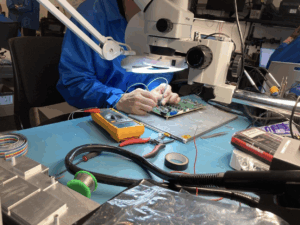 -Joseph Wilson The following is an (lightly edited) excerpt from Joseph Wilson’s forthcoming book Humans of AI: Understanding the People Behind the Machines to be published by University of Toronto Press in Spring 2026. Copyright Joseph Wilson 2025. Reprinted with permission of the publisher. “I picture the transistors as trembling bodies with translucent skin and… Read More »Pay No Attention to Those Engineers Behind the Curtain: The Hidden Infrastructure that Runs AI
 - Introduction: In/Visibility in Linguistic Anthropology
 -Sarah Muir & Courtney Handman Four times a year, Anthropology News puts out calls for submissions on a particular theme. The current theme of “in/visibility” prompted an incredible amount of interest from linguistic anthropologists working on an array of topics and in a wide range of fieldsites. With all of this interest, we wanted to… Read More »Introduction: In/Visibility in Linguistic Anthropology
 - Trump 2.0, reader submissions
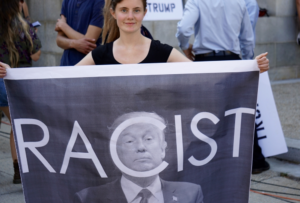 More scholars of language on Trump and Trumpism Send us yours to be added! Sorry Not Sorry: Political Apology in the Age of Trump Jan David Hauck Teruko Mitsuhara Glottopolítica Y Trump Presentación José del Valle El lenguaje muro: Racismo lingüístico de Donald Trump Lara Alonso Breves alcances sobre el léxico tabú y algunos de… Read More »Trump 2.0, reader submissions
 - A Reading List for Trump 2.0
 For those interested in what linguistic anthropology can tell us about Trump and Trumpism, SLA digital media recommends: On Trump himself: Janet McIntosh and Norma Mendoza Denton’s excellent edited volume Language in the Trump Era Kira Hall, Donna Goldstein and Matthew Ingram’s fantastic 2016 article, “The Hands of Donald Trump” On Digital Media and Political… Read More »A Reading List for Trump 2.0
 - What Does Free Speech Discourse Do? An SLA Online Discussion
 Please join the Society for Linguistic Anthropology for this important conversation, the first installment of its SLA Online programming. What Does Free Speech Discourse Do? An SLA Online Discussion Friday, January 24, 2025 – 11 AM to 12:30 PM CT This panel gathers a mix of scholars from within and without the field of linguistic… Read More »What Does Free Speech Discourse Do? An SLA Online Discussion
 - Researching the Right in the Era of Hurricane Truthers
 Margaret Rex, University of Buffalo In the aftermath of Hurricanes Helene and Milton, conspiracy theories seem to be everywhere. The tamest of these theories assert that FEMA is withholding aid from hurricane survivors and diverting funds to undocumented immigrants. The most bizarre of these theories assert that the Deep State and Democrats are using weather… Read More »Researching the Right in the Era of Hurricane Truthers
 - Summer Reading
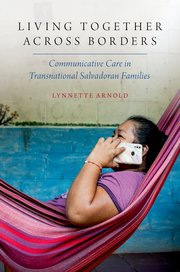 Recommendations from the Media Team: Alim, H.S. (2023). Inventing “the White voice”: Racial capitalism, raciolinguistics & culturally sustaining pedagogies. Daedalus,152(3), 147–166. https://doi.org/10.1162/daed_a_02023 Arnold, L. (2024). National heroes or dangerous failures: Mobilizing gender in Salvadoran migration discourse to create relational neoliberal personhood. Gender and Language, 17(4), 412-432. https://doi.org/10.1558/genl.22687 Barker, M. (2024). You have been misconnected. Critical Inquiry, 50(2), 201-224. https://doi.org/10.1086/727641 Clemons, A. M., Grieser,… Read More »Summer Reading
 - Talking Politics 2023: Conversations and Public Pedagogies Beyond the Webinar
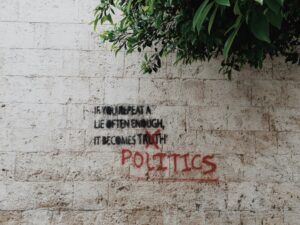 Joshua Babcock, Maureen Kosse, and Wee Yang Soh During the spring of 2023, students and early-career scholars at the University of Chicago and the University of Colorado Boulder launched the second edition of Talking Politics. Originally the brainchild of Lead Organizer Wee Yang Soh in 2020, this award-winning public webinar series was designed to showcase… Read More »Talking Politics 2023: Conversations and Public Pedagogies Beyond the Webinar
 - Gender Gaga vs Normal German: language, gender and education in Switzerland
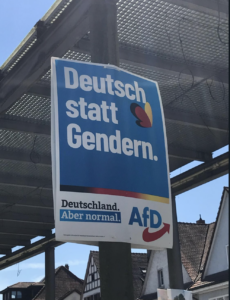 On the streets of Liestal in Switzerland, a former elementary school teacher gathers signatures to launch a cantonal initiative to teach “clear, linguistically correct, understandable and readable language (klare, sprachlich korrekte, verständliche und lesbare Varietäten) in schools. This seems innocuous, even boring, a bit out of place in a country prizing its many dialects. Next… Read More »Gender Gaga vs Normal German: language, gender and education in Switzerland
 - The “both-and,” non-binary semiotics of intersectionality
 Joshua Babcock and Jay Ke-Schutte In two recent special issues in Signs and Society and the Journal of Linguistic Anthropology, we outlined how we see intersectionality contributing to a raciolinguistic perspective. As we and the special issues’ contributors demonstrated, intersectionality offers two key interventions for linguistic anthropologists and other critical scholars of language: first, a… Read More »The “both-and,” non-binary semiotics of intersectionality
 - Linguistic Anthropology in Collaboration Across the Global North and South
 Among the four primary subfields of American anthropology, linguistic anthropology is arguably the least widely recognized and practiced globally (even as it overlaps in significant ways with fields such as applied sociolinguistics and linguistic ethnography that are more commonly practiced outside the United States). That said, scholars around the world are interested in the theoretical insights and methodological approaches the subfield offers. I, Erika Hoffmann-Dilloway, am a US based linguistic anthropologist whose research has taken place primarily in Nepal. Last year, I had the opportunity to participate in not only the linguistic anthropology of Nepal but also an emerging Nepali linguistic anthropology, when Professor Janak Rai of Tribhuvan University (TU) invited me to contribute to a series of curriculum development workshops aimed at supporting local scholars who are teaching and practicing the subfield. During that trip I also had a chance to visit Professor Nishaant Choksi, a linguistic anthropologist based at the Indian Institute of Technology, Gandhinagar (IITG). Recently, the three of us met over zoom to discuss the challenges and benefits of cultivating the study of linguistic anthropology at their institutions along with the potential promises and pitfalls of subfield-focused collaboration within and across the Global North and South.
 - Strengthening Social Justice Pedagogies: Creating Space(s) for Dialogue
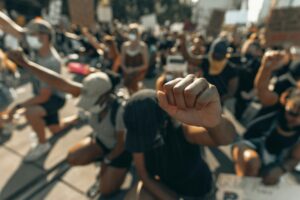 Lynnette Arnold and Anna Corwin Lynnette Arnold is Assistant Professor in the Department of Anthropology at the University of Massachusetts in Amherst. She has served as co-convener for the SLA Language and Social Justice Committee, and currently serves as an elected member-at-large on the SLA board. Anna Corwin is Associate Professor in the Department of… Read More »Strengthening Social Justice Pedagogies: Creating Space(s) for Dialogue
 - Book Excerpt: “Language and Revolutionary Magic in the Orinoco Delta” by Juan Luis Rodriguez
 [This is an excerpt from Language and Revolutionary Magic in the Orinoco Delta, which won the SLA New Voices 2021 Book Prize] This book is about the distribution of political gifts and the changing linguistic practices that mediate the relationship between the Warao of the Orinoco Delta and Venezuelan politicians. In a broader sense it… Read More »Book Excerpt: “Language and Revolutionary Magic in the Orinoco Delta” by Juan Luis Rodriguez
 - An Unconventional Plan
 By Eva Rothenberg One of the first ambitious proposals put forth by the Biden administration has caused a linguistic schism between Democrats and Republicans, the fissures along the same ideological lines highlighted through language. Underlying the palaver of budget constraints and bipartisan support, President Joe Biden’s American Jobs Plan raises questions about the semantic minutiae… Read More »An Unconventional Plan
 - Creative Contributions: Undergraduates apply linguistic anthropological insights beyond the classroom
 Catherine R. Rhodes In my recent upper-division, undergraduate course, Language and Culture, most students were unfamiliar with linguistic anthropology, with what linguistic anthropologists do, and the potential value of the sub-field’s contributions. Many students enrolled in the course because it is a requirement for the undergraduate BA program in Ethnology (cultural-linguistic anthropology) or because it fulfills… Read More »Creative Contributions: Undergraduates apply linguistic anthropological insights beyond the classroom
 - Gender Comes to Germany
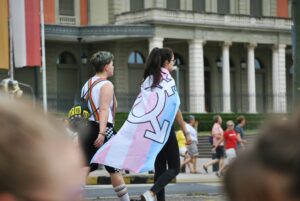 Colin Halverson, PhD In 2017, Katrin Göring-Eckhardt, a Green Party member of the German federal parliament, addressed an audience of children as “Liebe Kinderinnen und Kinder” (‘Dear childrenF and children), drawing the ire of many Twitter users, especially those on the far right of the political spectrum. The humor (or horror) of Göring-Eckhardt’s salutation was the… Read More »Gender Comes to Germany
 - “Deaf Community Deserves Greater Access to Medical Information during Covid-19”
 Above photo: Image of the American Sign Language sign for ‘Interpreter’”. https://www.ai-ada.com/language-access-professionals/sign-language-interpreters/ By Claire Cummings One click. The news pops up on your TV and you see the Governor of New York’s press briefing. In the corner of the screen near him there is a very animated individual clad in all black gesturing with their hands.… Read More »“Deaf Community Deserves Greater Access to Medical Information during Covid-19”
 - “Social Distancing and the Cultural Semiotics of Contact”
 By Luke Fleming and James Slotta In the images and stories of families that have been separated by the spread of coronavirus, we have some of the more poignant tokens of the way the pandemic is affecting people across the world. Stories of people unable to visit family in the hospital, of mothers seeing their… Read More »“Social Distancing and the Cultural Semiotics of Contact”
 - “Code-Switching and Standardizing Singlish”Image, top: taglines and artwork from the 2019 Speak Good English Movement, “Let’s connect. Let’s speak good English.” Image, bottom: screen capture from “Code-Switching” by Singaporean sketch comedy duo the BENZI Project (youtu.be/mCnfF6Owc2s). By Josh Babcock In Singapore, code-switching is everywhere. Perhaps better, talk about code-switching is everywhere. When Singaporeans use the term “code-switching,” however,… Read More »“Code-Switching and Standardizing Singlish”
- “Subtitled Dreams”By Chu May Paing I dream about the day when I am no longer praised for my “well-articulated” thoughts. The week before the Reading Week in the fall of 2018 was a typical week for the final review at the University of Colorado, Boulder. In the last recitation for a large undergraduate introductory course on… Read More »“Subtitled Dreams”
- “Teaching to Advance Social Justice”Author with students and community partners at course event By Lynnette Arnold At the start of every semester, I find myself pondering again the significance of linguistic anthropology. In my introductory courses, students are often encountering the field for the first time, but even conversations with students who have taken many of our classes prompt… Read More »“Teaching to Advance Social Justice”
- “Respecting Identity: Amazigh Versus Berber”By Adeli Block I have found that scholars and non-scholars alike still continue to refer to the indigenous peoples and languages of North Africa as “Berber.” For example, when speaking about my research interests, I say, “I’m studying Tamazight, a dialect of the indigenous language of Morocco,” and people tend to respond with “Oh, you… Read More »“Respecting Identity: Amazigh Versus Berber”
- “Transposition Across Subfields”By Steven Black Working at the intersection of anthropological subfields often involves thinking laterally, connecting parallel threads of scholarship in distinct subdisciplines. For me, these connections seem to become apparent only at the very end of my preparation of a publication. Perhaps this is in part because it can take a great deal of time… Read More »“Transposition Across Subfields”
- “Creating Online Resources for Language Revitalization”Above photo: Interview with Former Headmaster of Boro School, 2018. Fieldwork for Archive for Northeast Indian Languages. By Christina Wasson The United Nations declared 2019 the International Year of Indigenous Languages to “focus global attention on the critical risks confronting indigenous languages” and to “increase the capacity of all stakeholders to take measures that will support,… Read More »“Creating Online Resources for Language Revitalization”
- “Making Transcripts Public in Manding”By Coleman Donaldson Linguistic anthropologists pass hours transcribing and translating recordings of public and not-so-public figures from across the world. We do so, in part,because we are committed to understanding language as a tool that allows human beings to continually make and remake the world in which we live. But can our transcripts and… Read More »“Making Transcripts Public in Manding”
- “Students’ open letters to Disney”By Sarah Benor I teach a freshman seminar at the University of Southern California called “Language, Race, and Identity in the United States Today.” Students learn about linguistic diversity among American racial and ethnic groups, focusing on language discrimination. After reading parts of Rosina Lippi-Green’s book English with an Accent, we analyze clips from films… Read More »“Students’ open letters to Disney”
- “Comedy in the Archives”[Photo Credit: Mike Lovett/Brandeis University] by Michael Prentice In my fall course, “Language in American Life,” we explored a range of topics focusing on linguistic authority, from playground politics to law school lectures, from monoglot standards to media neutrality. For the students’ mid-term essay, I wanted them to think through some new empirical material. By… Read More »“Comedy in the Archives”