By Luke Fleming and James Slotta
In the images and stories of families that have been separated by the spread of coronavirus, we have some of the more poignant tokens of the way the pandemic is affecting people across the world. Stories of people unable to visit family in the hospital, of mothers seeing their newborns for the first time weeks after they were born, of people saying goodbye to loved ones over video chat, of funerals that few can attend—these are the heartbreaking hallmarks of “social distancing,” a practice needed to slow the circulation of the virus, but antithetical to a deeply ingrained sense of the importance of human contact.
In the past few years one of us [LF] has been combing through ethnographic, missionary and colonial literatures that document avoidance practices from around the world. In these literatures, regulations on contact especially among kin are very much the heart of the matter. It is not unusual to encounter rules like the one reported by Yubu Okello on “Lango marriage”: “If a woman wishes to talk to her son-in-law, there must be an opaque partition between them” (1951: 72).
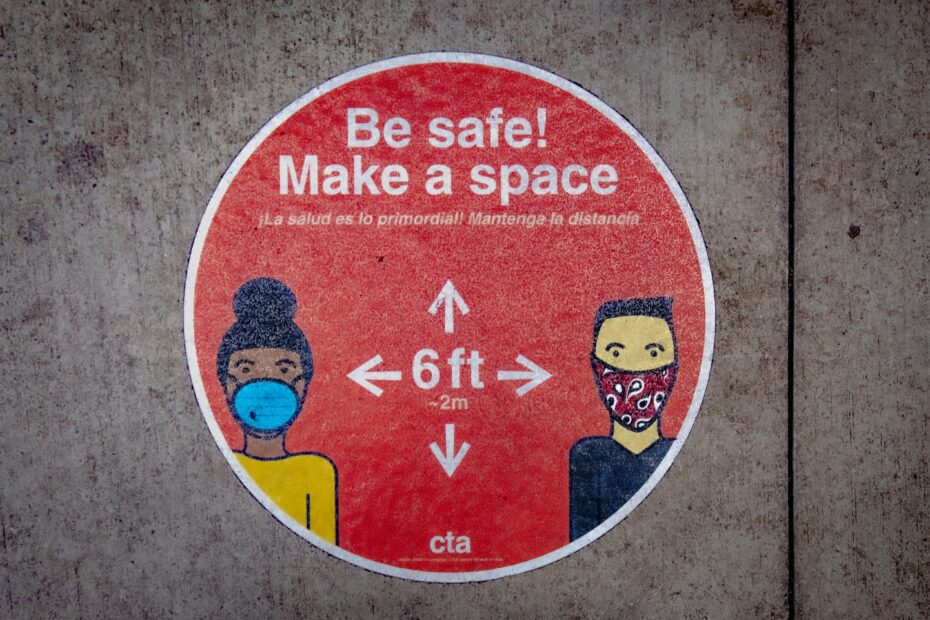
Images like the one above cast these sorts of injunctions in a new light (see Image 1). Now, throughout the world, people are experiencing the need for partitions and masks, isolation and avoidance behaviors that ensure distance. And this is bringing home what a significant and signifying resource human contact is.
Rules of avoidance in kinship-centered societies have long provided evidence of the significance of interpersonal contact as a semiotic resource. Through these rules, different modes and degrees of contact come to serve as the means of signaling different kinds and intensities of social relationality. Perhaps best known to linguistic anthropologists are injunctions against touching, making eye contact, sharing objects, and speaking directly with in-laws in Aboriginal Australian communities (Merlan 1997).
We hear echoes of such contact-attuned sensibilities in the current crisis. When Mom says she’s been disinfecting the bottom of Dad’s shoes when he comes in from a walk, or when the New York Times voices our worries by asking “Is the virus on my clothes? My shoes? My hair? My newspaper?”, we see how objects have now come to be regarded as vectors of contact with, often spectral, social others. When we see the poignant pictures of children visiting their parents through the pane glass partitions of their senior care rooms, we are struck by how considerations of contact have come to dominate people’s interpersonal comportment.
We are also struck by how quickly closeness and contact have been reconfigured, how physical distance has become a feature of even the “closest” social relationships. In the face of recent injunctions to social distance, proximity has come to signify exposure and distance has come to signal solicitous care, at least for some. For others, it has become a mark of political identity. These significations have been layered on top of cultural values of proximity that have deep roots. The performative values of contact sanctified across a lifetime, embodied in personal habitus, cannot simply, through authoritative and explicit stipulation, be so easily reversed and overwritten. Lamentations for the loss of our proxemic rituals—overwrought though they might be—and the search for alternatives to handshakes, kisses, and hugs point to a long-standing, socially ingrained sense of the significance of contact. We are pulled in opposite directions by contradictory cultural sensibilities concerning contact.
The transformations happening before our eyes are a reminder that interpersonal contact is a thoroughly semiotic affair, mediated by variable and changeable cultural frameworks that give it significance. “Intercorporeality”—the experienced relationship between bodies—is a fundamental facet of human experience. As the editors of a recent book on the subject point out, “the body is never alone in the first place, or only in conditions of deprivations that we consider inhumane” (Meyer, Streeck, and Jordan 2017: xvii). But this volume also makes abundantly clear that the management and significance of this intercorporeality is a cultural matter through and through. Far from inhumane, social distancing may be a matter of respect, of caring for others, of ensuring their safety.
Social distancing, we might say, is an emergent semiotic register—“a repertoire [of signs]… associated, culture internally, with particular social practices and with persons who engage in such practices” (Agha 1999: 216). Like the stereotyped avoidance practices documented in many kin-centered societies, it is a register whose signs consist of modes and degrees of interpersonal contact. And like those other avoidance registers, social distancing is informed by ideologies of contact and exposure (though these are certainly not always strictly viral). All of these registers involve what linguistic anthropologists have studied under the heading of ‘phaticity’ and ‘phatic rituals’: culturally informed sensibilities about interpersonal contact of various sorts (Nozawa 2015; Slotta 2015).
In speaking of “social distancing” as a register, the focus on “cultures” and “ideologies” of contact may seem misplaced, given the very materiality of the virus. One might be tempted to think that North American viral imaginaries are profoundly different in kind from the contact imaginaries of Korowai sons-in-law, for whom a wide array of kinship avoidances are understood in terms of the dangers of “bodily and personal impingement” (Stasch 2003: 324). But social distancing and kinship avoidance both construe contact as a vector with inherent, negatively valued, causal and affective potential. Indeed, in our research on avoidance registers, contact is again and again a prime semiotic medium in which ideologies concerning material bodies and their physical effects on one another find expression (Fleming n.d.). The virus is completely material to those who buy the representation of it offered by public health officials or who otherwise lie within its “sphere of communicability” (Briggs 2005). But the dangers of contact are similarly material to Korowai sons-in-law, who rigorously avoid their mothers-in-law as a consequence. (Describing another group in West Papua, Oosterwal (1961: 163), for instance, tells us that if a Berik man speaks directly with his mother-in-law that he “will be plagued with severe headaches” and that if he should eat sago-mash prepared by her that he “will get a violent pain in his insides and will probably die.”)
We should be careful not to etherealize the sense of materiality that inspires kinship avoidance behaviors, rendering it a purely intellectual matter of culture or ideology. At the same time, we must be careful not to physicalize the act of “social distancing,” ignoring the elaborate cultural frameworks and discursive mediations that underpin this avoidance register. As linguistic anthropologists we should seek to do justice to the play of materiality and ideology registered in human contact. For the present circumstances, that means we will likely be living with the ambivalences and contradictory feelings that arise as we come to habituate ourselves to embodying a new and different “culture of contact.”
Works Mentioned
-Agha, Asif. 1999. “Register.” Journal of Linguistic Anthropology 9(1-2):216-219.
-Briggs, Charles L. 2005. “Communicability, Racial Discourse, and Disease.” Annual Review of Anthropology 34(1): 269–91.
-Fleming, Luke. forthcoming. “The elementary structures of kinship interaction: Corporeal communication in joking-avoidance relationships.” Texas Linguistics Forum (i.e. SALSA XXVII Proceedings).
-Merlan, Francesca. 1997. “The mother-in-law taboo: Avoidance and obligation in Aboriginal Australian society.” In Francesca Merlan, John A. Morton & Alan Rumsey (Eds.), Scholar and sceptic: Australian Aboriginal studies in honour of L. R. Hiatt (pp. 95-122). Canberra: Aboriginal Studies Press.
-Meyer, Christian, Jürgen Streeck, & J. Scott Jordan. 2017. Intercorporeality: Emerging Socialities in Interaction. New York: Oxford University Press.
-Nozawa, Shunsuke. 2015. “Phatic traces: Sociality in contemporary Japan.” Anthropological Quarterly 88(2):373-400.
-Okello, Yubu. 1951. “Lango marriage.” Uganda Journal 15(1):65-73.
-Oosterwal, Gottfried. 1961. People of the Tor: A cultural-anthropological study of the tribes of the Tor territory (Northern Netherlands New-Guinea). Assen, The Netherlands: Royal van Gorcum Ltd.
-Slotta, James. 2015. “Phatic rituals of the liberal democratic polity: Hearing voices in the hearings of the Royal Commission on Aboriginal Peoples.” Comparative Studies in Society and History 57(1):130-160.
-Stasch, Rupert. 2003. “Separateness as a Relation: The Iconicity, Univocality and Creativity of Korowai Mother-in-Law Avoidance.” Journal of the Royal Anthropological Institute 9:317-337.
From JLA
The co-editors-in-chief (Das and LaDousa) of the Journal of Linguistic Anthropology are proud to feature three outstanding articles contributing to the analysis of social distancing in the current pandemic era. Mitchell (2018) analyzes Datooga in-law avoidance register in terms of stance; Scott (2012) explores semiotic forms mediating governmentality in Bolivian community health; and Smith and Barad (2018) theorize phatic function in the parental control of gaming in Peru.
-Mitchell, Alice. 2018. “Allusive References and Other‐Oriented Stance in an Affinal Avoidance Register.” Journal of Linguistic Anthropology 28(1): 4-21. Click here to access.
-Scott, Stephen Kingsley. 2017. “The Politics of Commiseration: On the Communicative Labors of “Co‐Mothering” in El Alto.” Journal of Linguistic Anthropology 27(2): 171-189. Click here to access.
-Smith, Benjamin and Ashley Barad. 2018. “Digital Gaming and the Arts of Parental Control in Southern Peru: Phatic Functionality and Networks of Socialization in Processes of Language Socialization.” Journal of Linguistic Anthropology 28(3): 384-399. Click here to access.